
Vocal Tract
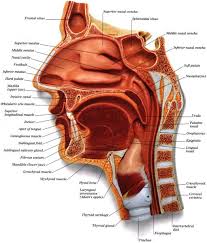
To produce speech, air must flow from the lungs through the vocal tract, which includes the vocal folds.
The vocal folds vibrate for some sounds but not for others. Air flows through the nose for certain sounds but not others.
But the main creator of speech sounds is the mouth.
The vocal tract is the cavity in human beings, where sound is filtered.
The estimated average length of the vocal tract in adult male humans is 16.9 cm and 14.1 cm in adult females.
The space between the vocal cords is called the glottis. When the vocal cords vibrates, the resulting disturbance in the air imparts a "buzzing" quality to the speech, called voice or voicing.
In addition to their normal names, many of the parts of the vocal tract have fancy names derived from Latin and Greek. The adjectives we use to describe sounds made with each part are usually based on the Latin/Greek name.
| Normal name | Fancy name | Adjective |
| lips | labia | labial |
| teeth | dental | |
| alveolar ridge | alveolar | |
| (hard) palate | palatal | |
| soft palate | velum | velar |
| uvula | uvular | |
| upper throat | pharynx | pharyngeal |
| voicebox | larynx | laryngeal |
| tongue tip | apex | apical |
| tongue blade | lamina | laminal |
| tongue body | dorsum (back) | dorsal |
| tongue root | radical |
In phonetics, the terms velum, pharynx, larynx, and dorsum are used as often or more often than the simpler names.
alveolar ridge
A short distance behind the upper teeth is a change in the angle of the roof of the mouth. (In some people it's quite abrupt, in others very slight.) This is the alveolar ridge. Sounds which involve the area between the upper teeth and this ridge are called alveolars.
(hard) palate
The hard portion of the roof of the mouth. The term "palate" by itself usually refers to the hard palate.
soft palate/velum
The soft portion of the roof of the mouth, lying behind the hard palate. The tongue hits the velum in the sounds [k], [g], and [ŋ]. The velum can also move: if it lowers, it creates an opening that allows air to flow out through the nose; if it stays raised, the opening is blocked, and no air can flow through the nose.
uvula
The small, dangly thing at the back of the soft palate. The uvula vibrates during the /r/ sound in many French dialects.
pharynx
The cavity between the root of the tongue and the walls of the upper throat.
tongue blade
The flat surface of the tongue just behind the tip.
tongue body/dorsum
The main part of the tongue, lying below the hard and soft palate. The body, specifically the back part of the body (hence "dorsum", Latin for "back"), moves to make vowels and many consonants.
tongue root
The lowest part of the tongue in the throat
epiglottis
The fold of tissue below the root of the tongue. The epiglottis helps cover the larynx during swallowing, making sure (usually!) that food goes into the stomach and not the lungs. A few languages use the epiglottis in making sounds. English is fortunately not one of them.
vocal folds/vocal cords
Folds of tissue stretched across the airway to the lungs. They can vibrate against each other, providing much of the sound during speech.
glottis
The opening between the vocal cords. During a glottal stop, the vocal cords are held together and there is no opening between them.
larynx
The structure that holds and manipulates the vocal cords. The "Adam's apple" in males is the bump formed by the front part of the larynx.